Summarize with ChatGPTClaudePerplexity
TL;DR
- Query fan-out breaks one complex question into multiple narrower searches, retrieves evidence from those branches and combines the results into one answer.[2][9]
- Google explicitly describes AI Mode as searching multiple subtopics simultaneously across multiple data sources.[7][1]
- Google says AI Overviews and AI Mode may use query fan-out, but it does not publish a fixed number of searches for every prompt.[6]
- OpenAI says ChatGPT Search rewrites queries into targeted searches and may issue additional queries after reviewing initial results.[3][5]
- Query fan-out is broader than query expansion because it creates multiple focused search branches rather than only adding terms to one query.
What Is Query Fan-Out in AI Search?
Query fan-out is the process of breaking one complex search question into multiple narrower searches, running those searches across related subtopics or data sources, and combining the results into one answer. Google explicitly uses the term for AI Mode and says the technique can also support AI Overviews.[1]
A simple model is:
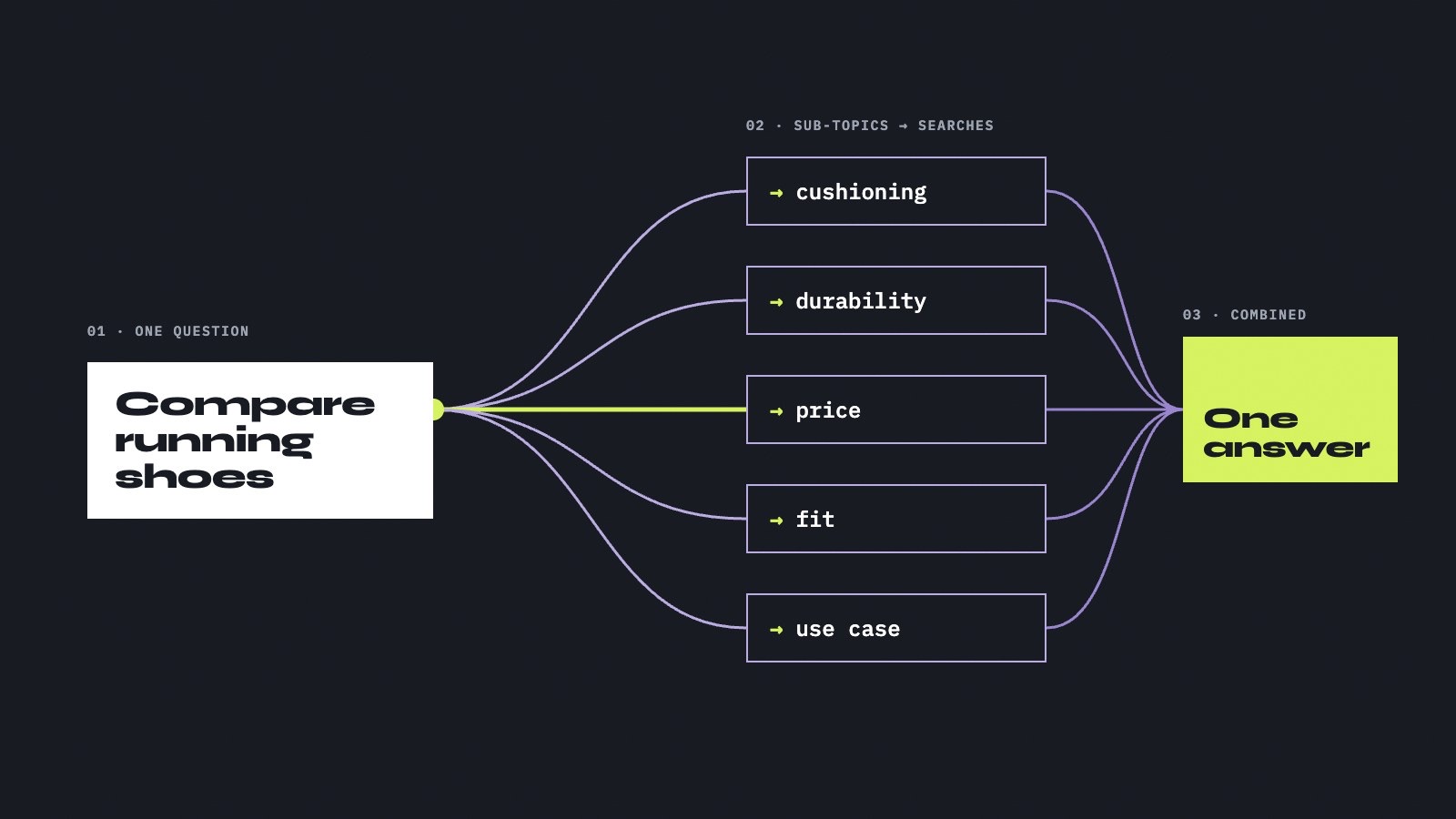
One question → multiple search branches → retrieved evidence → one synthesized response
For example, a user might ask:
“Which laptop is best for university students who need long battery life, light weight, strong performance and a reasonable price?”
A traditional search engine might return pages about “best student laptops.” An AI search system using fan-out could separately investigate battery life, weight, processor performance, price, reliability and current reviews. It then uses the results to produce a comparison.
Query fan-out is therefore not just query rewriting. Rewriting changes a user’s wording into a search-engine-friendly query. Fan-out expands the task into several related searches that address different parts of the underlying information need.[2]
How Does Query Fan-Out Work?
Google describes AI Mode as dividing a question into subtopics and searching for each one simultaneously across multiple data sources. It then combines those results into a response with supporting links.[2]
The exact implementation can differ by product. Google documents concurrent searches for AI Mode, while OpenAI says ChatGPT Search typically rewrites a user’s query into one or more targeted queries and may issue additional, more specific queries after reviewing initial results.[3]
The query fan-out process
-
Interpret the original question.
The system identifies the user’s goal, constraints, entities and implied follow-up questions. A request to compare running shoes, for example, may contain subtopics such as cushioning, durability, price, fit and use case. -
Decompose the question into subtopics.
The system creates narrower search branches that address different aspects of the request. These branches may cover factual information, comparisons, current availability, reviews or sources specific to a location. -
Generate targeted queries.
Each branch becomes one or more search queries. Some queries may use different wording, entities, filters or sources to improve coverage. -
Run searches across available sources.
Google says AI Mode issues multiple related searches simultaneously across subtopics and data sources.[1][4] OpenAI’s documentation describes targeted queries sent to search providers and possible follow-up searches, but does not specify that ChatGPT uses Google-style parallel execution.[3] -
Review and refine the evidence.
Search results can reveal missing information or suggest more specific follow-up queries. OpenAI says ChatGPT Search may send additional, more specific queries after reviewing initial results.[5][3] -
Aggregate relevant results.
The system collects evidence from the branches and determines which information is relevant to the original request. -
Synthesize the answer.
The model combines the evidence into a response, often with citations or links to supporting pages. -
Preserve the user’s constraints.
The final answer should reflect the original requirements, such as budget, location, date, audience or product specifications.
Fan-out does not mean that every possible related query is always searched. The system chooses branches based on the question, available information and the product’s retrieval design. Google’s public documentation explains the technique but does not provide a fixed number of searches for every prompt.[6]
What Are Examples of Query Fan-Out?
Google’s published examples show how fan-out can support complex comparisons, transactions and multimodal searches. These are product examples from Google rather than independent performance tests.[7]
| User request | Possible fan-out branches | Resulting answer |
|---|---|---|
| “Compare a smart ring, smartwatch and tracking mat for sleep” | Sleep metrics, sensors, battery life, comfort, app quality, price and device comparisons | A structured comparison of the three product categories |
| “Find two affordable lower-level tickets for this Saturday’s Reds game” | Event details, ticket inventory, seating sections, prices, fees and seller availability | Ticket options that match the date, quantity, location and budget |
| “Find the items in this outfit image” | Separate visual searches for the hat, shoes, jacket and other clothing pieces | Identification or suggestions for the individual items |
| “What is the best family car for winter driving?” | Safety ratings, all-wheel drive, cargo space, child-seat compatibility, fuel economy, price and regional availability | A recommendation based on several decision factors |
| “How should a small business choose an email platform?” | Pricing, automation, deliverability, integrations, templates, support and business size | A comparison organized around the buyer’s requirements |
Google says its AI Mode example for Reds tickets can search across sites, examine hundreds of ticket options with real-time pricing and inventory, and support form-filling.[8] In another example, Google describes AI Mode using simultaneous Lens searches to identify separate pieces of an outfit image.[9]
The number of branches is not fixed. A simple factual question may require little or no visible expansion, while a comparison or planning request can require many searches across different sources.
Why Does Fan-Out Matter for AI Search?
Fan-out helps AI search systems handle questions that would traditionally require several separate searches. Google positions AI Mode as useful for exploration, reasoning and complex comparisons that may previously have required multiple searches.[9]
It covers more dimensions of a question
A single search query can underrepresent a complex request. Fan-out lets the system investigate multiple dimensions separately instead of relying on one broad phrase.
For example, “best project-management tool for a distributed agency” may require research into:
- Client permissions
- White-label reporting
- Collaboration features
- Integrations
- Pricing
- Time tracking
- Automation
- Security
- Agency-specific workflows
It can improve source diversity
Google says AI Overviews and AI Mode may use fan-out to issue related searches across subtopics and data sources, allowing the response to display a wider and more diverse set of helpful links.[4][10]
That does not guarantee that every source is equally authoritative or that the final response will be complete. It means the retrieval process can look beyond the result set of one conventional query.
It supports follow-up reasoning
A search branch can expose information that changes what the system needs to investigate next. For instance, a product comparison may reveal that a key model is unavailable in the user’s country, prompting a search for alternatives.
This makes fan-out partly iterative. The system may begin with planned branches, inspect results, and then create more specific searches.
It changes how websites can become visible
A page does not need to rank for the exact wording of the user’s original prompt to be relevant to one of its branches. It may instead answer a narrower question, support a comparison, provide a product specification or clarify an important constraint.
This is why AI-search visibility analysis increasingly looks at the prompts, sources and subtopics that appear behind an answer—not only the final wording displayed to the user.
How Does Google AI Mode Use Fan-Out?
Google’s official documentation gives the clearest public description of query fan-out. AI Mode divides a question into subtopics and searches for each one simultaneously across multiple data sources before bringing the results together.[1]
Google has described fan-out in several contexts:
- A complex product comparison can be decomposed into multiple research steps.[9]
- A ticket-search request can branch across websites to evaluate inventory, prices and seating options.[11][8]
- A visual shopping request can use separate Lens searches for different objects in an image.[9][7]
Google also says that both AI Overviews and AI Mode may use query fan-out.[4] The wording matters: “may use” does not mean that every query triggers the same process or that every response contains the same number of branches.
Fan-out in Google AI Overviews
AI Overviews can use fan-out to investigate related subtopics and data sources before generating a summary.[4] The user may see a concise answer with links, while the underlying retrieval process may have covered several related searches.
Fan-out in Google AI Mode
AI Mode is designed for more exploratory questions, comparisons and follow-up interaction. Google says its fan-out searches can run concurrently, which can provide broader coverage than a single traditional search.[1][3]
The public documentation does not establish a universal fan-out pattern, fixed query count or guaranteed sequence for every AI Mode response. As an observed data point rather than a Google specification, Finseo’s own query fan-out study found that AI Mode rewrites one prompt into about nine synthetic searches, and 95% of them have zero search volume.
How Does ChatGPT Search Expand Queries?
OpenAI says ChatGPT Search typically rewrites a user’s query into one or more targeted queries sent to search providers.[3][5] After reviewing initial results, it may send additional, more specific queries to other providers.[5][3]
That creates a process similar to fan-out in the broad sense:
- The user submits a question.
- ChatGPT interprets the information need.
- It rewrites the question into targeted search queries.
- It reviews the initial search results.
- It may issue additional queries.
- It synthesizes an answer from the retrieved information.
OpenAI’s public documentation does not specify an exact query count, whether all queries run in parallel or which scheduling algorithm determines follow-up searches.[3] It is therefore more accurate to say that ChatGPT Search performs query rewriting and may perform follow-up retrieval than to claim that it implements Google’s documented concurrent fan-out method.
What do observed ChatGPT searches show?
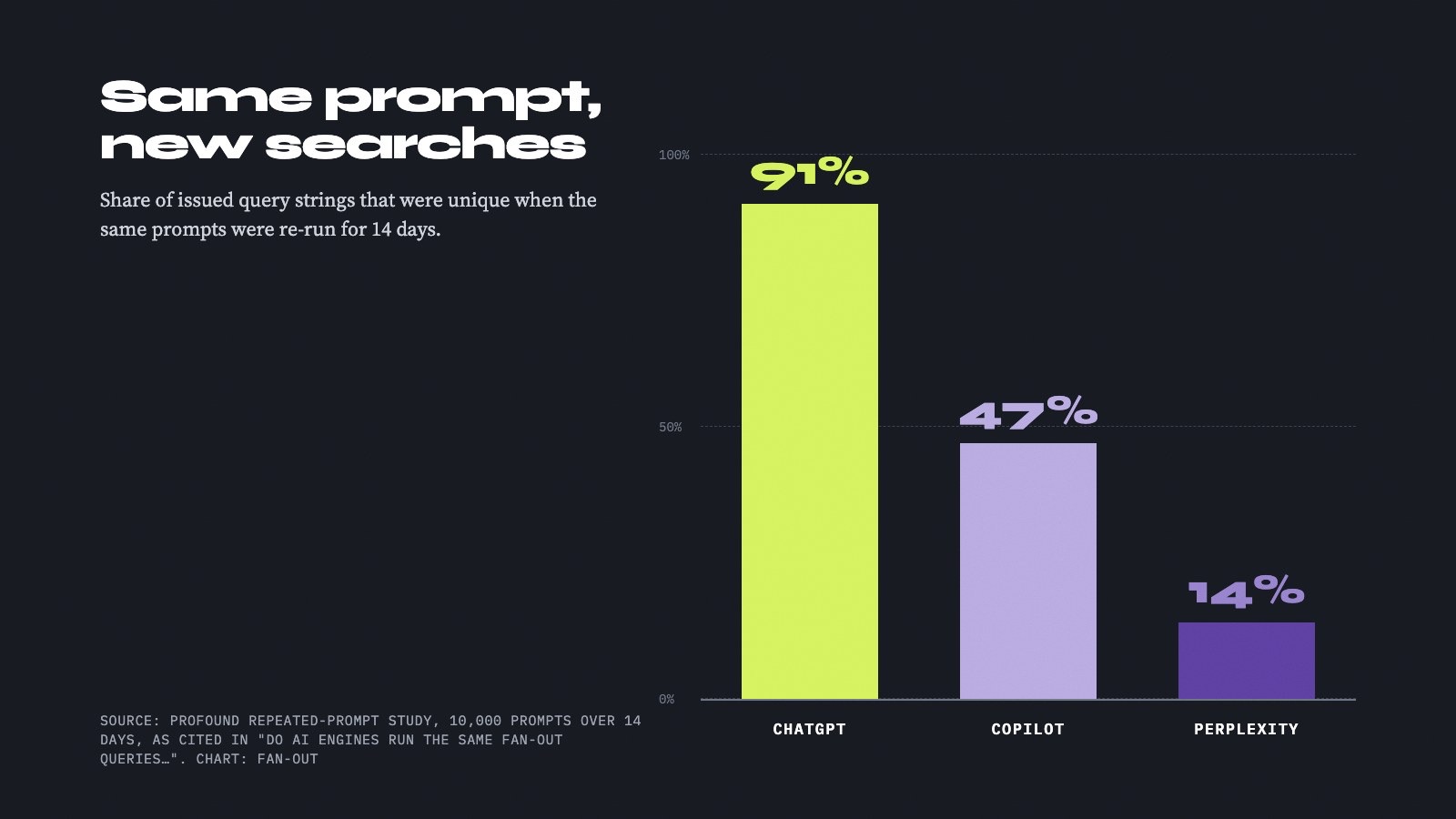
Third-party analyses have reported query traces from particular datasets and logged sessions, but those observations are not equivalent to an OpenAI product specification. One practitioner report based on a single logged-in account described roughly 15 to 40 subqueries for some product-comparison tasks, while cautioning that the sample was small and directional.[6][12]
Another vendor-reported analysis examined more than 10 million prompts and 20 million ChatGPT fan-out queries. It reported that some non-English prompts produced English-language research steps, but the findings came from that vendor’s dataset rather than a representative panel of all ChatGPT users.[3]
These observations can help explain how search branching may appear in practice, but they should not be treated as universal behavior. Query counts can vary by model, prompt, location, language, search availability and task complexity. In Finseo’s own analysis of German-language (DACH) ChatGPT answers, which is also vendor data rather than a representative panel, ChatGPT ran 1.36 searches per answer (median one; 72.3% of answers ran exactly one search), and 7.9% to 19.5% of ChatGPT searches for German prompts were in English.
What Is the Difference Between Query Fan-Out and Query Expansion?
Query expansion usually means adding related terms, synonyms, entities or variants to improve retrieval for one search task. Query fan-out is broader: it divides a complex information need into multiple search branches, often covering different subtopics or sources.
| Concept | Main action | Example |
|---|---|---|
| Query rewriting | Rephrase the user’s query | “restaurants near me” becomes “top restaurants San Francisco” |
| Query expansion | Add related terms or variants | “running shoes” becomes “running shoes cushioning marathon durability” |
| Query fan-out | Create multiple focused searches | Separate searches for cushioning, durability, price and marathon suitability |
| Query decomposition | Split a complex request into subquestions | Break a research question into independently retrievable parts |
| Retrieval synthesis | Combine retrieved evidence into an answer | Merge product specifications, reviews and pricing into a recommendation |
The boundaries are not always strict. A fan-out system may use query rewriting and query expansion inside each branch. In practice, “fan-out” emphasizes the multi-branch structure, while “rewriting” emphasizes the transformation of the original wording.
Academic research on retrieval-augmented generation describes query decomposition as splitting complex requests into subqueries, retrieving documents for those subqueries and aggregating the evidence into an answer.[13] That research provides useful technical context, but it is not proof that Google or OpenAI uses the same implementation.
What Do Query Fan-Out Patents Show?
Patents can describe mechanisms related to query expansion, thematic search and follow-up retrieval. They do not, by themselves, prove that a specific patented mechanism is deployed in a live AI-search product.
Which patents are related to query fan-out?
Google patent US12158907B1, “Thematic search,” describes generating themes from search-result content, organizing results by theme and allowing a selected theme to trigger a further query and additional subthemes.[14][15] This is relevant to topic grouping and search expansion, but the patent record does not establish that the exact mechanism is deployed in AI Mode.[6]
Google patent US11663201B2, “Generating query variants using a trained generative model,” describes a model that produces query variants and a controller that can use search-response features to decide whether to generate additional variants or follow-up variants.[16] It is relevant to query expansion, but it should be cited as a patent disclosure rather than proof of a particular live product implementation.
Patent applications and granted patents can cover possible techniques, alternative embodiments or future product directions. They should therefore be used as technical context, not as direct evidence of how a current AI search product operates.
How Can Marketers Analyze Query Fan-Out?
Marketers cannot usually see every internal search step for every AI answer. However, they can study the visible evidence around AI-search responses and create content that answers the narrower questions likely to influence retrieval.
Useful analysis areas include:
- Prompt decomposition: Identify the subquestions implied by important customer prompts.
- Source coverage: Check which pages, domains and source types appear in AI answers.
- Citation patterns: Compare the pages cited for the main topic and related subtopics.
- Competitor gaps: Find branches where competitors are mentioned but the brand is absent.
- Content completeness: Ensure pages answer practical follow-up questions, not only the headline topic.
- Regional and language coverage: Check whether important branches are searched in the language and market of the user.
- Answer evidence: Compare the claims in AI responses with the sources cited for them.
A useful workflow is:
- Select a complex customer question.
- List the decision factors hidden inside it.
- Turn each factor into a plausible narrower query.
- Search those branches separately.
- Record which pages and competitors appear.
- Identify unanswered branches.
- Create or improve content for those gaps.
- Recheck the original question and its related searches over time.
This approach does not reveal an AI system’s private retrieval algorithm. It provides a practical approximation of the information landscape that may support an answer.
Why Does Fan-Out Matter for SEO and GEO?
Traditional SEO often focuses on ranking for individual keywords. AI-search optimization adds another layer: whether a page can serve as useful evidence for one or more subtopics inside a larger answer.
For example, a page about “best accounting software” may be relevant to the main comparison, but separate pages about integrations, small-business pricing, tax support and automation may answer the narrower branches more effectively.
Fan-out increases the importance of:
- Clear headings that expose distinct subtopics
- Direct answers to specific questions
- Verifiable facts and supporting citations
- Structured comparisons
- Current pricing and availability information
- Strong entity relationships
- Internal links between related topics
- Content that addresses objections and follow-up questions
A page that is easy to retrieve for a narrow branch may contribute to an AI answer even if it does not contain the exact original prompt. Conversely, a page with a broad headline but little supporting detail may be less useful for individual branches.
Fan-out is not a ranking guarantee. Visibility depends on the search product, query, language, location, competition, source quality and the system’s retrieval and synthesis decisions.
Frequently asked questions
What is query fan-out?
Query fan-out is an AI-search technique that divides one complex question into multiple related searches across subtopics or data sources. The system retrieves evidence from those branches and combines it into one response.[2]
What does fan-out mean in Google AI Mode?
In Google AI Mode, fan-out means breaking a question into subtopics and issuing multiple related searches simultaneously across multiple data sources.[8][1] Google says the results are then brought together into an understandable response.
Does ChatGPT use query fan-out?
OpenAI says ChatGPT Search typically rewrites a user’s question into one or more targeted queries and may issue additional, more specific queries after reviewing results.[3] OpenAI’s public documentation does not specify that ChatGPT always uses Google-style parallel fan-out or reveal a fixed query count.
How many searches does an AI fan-out create?
There is no publicly documented universal number. The number can vary with the question, product, model, language, location, available sources and task complexity; Google’s documentation describes the method without setting a fixed count.[3][6]
Is query fan-out the same as query expansion?
No. Query expansion generally adds terms or variants to improve one search, while fan-out creates multiple focused branches for different parts of a complex information need. A fan-out system may use expansion or rewriting within each branch.
How should websites optimize for AI query fan-out?
Websites should answer the main topic and the narrower follow-up questions that support it. Clear structure, useful evidence, current facts, specific comparisons and pages that address distinct subtopics can make content more suitable as supporting material, although no method guarantees inclusion in an AI answer.
Sources
- 1Expanding AI Overviews and introducing AI Mode — blog.google
- 2Question Decomposition for Retrieval-Augmented Generation — aclanthology.org
- 3ChatGPT Search Often Switches To English In Fan-Out Queries: Report — searchenginejournal.com
- 4AI Features and Your Website | Google Search Central | Documentation | Google for Developers — developers.google.com
- 5Searching the web with ChatGPT | OpenAI Help Center — help.openai.com
- 6How ChatGPT Actually Picks Sources — searchenginejournal.com
- 7Inside ChatGPT Search: how web.run and fan-out queries shape AI visibility — searchengineland.com
- 8AI Mode in Google Search: Updates from Google I/O 2025 — blog.google
- 9Google expert explains AI Mode in Search’s query fan-out method — blog.google
- 10US6772150B1 - Search query refinement using related search phrases - Google Patents — patents.google.com
- 11Learning to Explore and Select for Coverage-Conditioned Retrieval-Augmented Generation — aclanthology.org
- 12How ChatGPT Actually Picks Sources (I Read the Network Traffic, Not the Outputs) — Suganthan — suganthan.com
- 13Query Decomposition for RAG: Balancing Exploration-Exploitation - ACL Anthology — aclanthology.org
- 14US12158907B1 - Thematic search - Google Patents — patents.google.com
- 15US20240386046A1 - Thematic search - Google Patents — patents.google.com
- 16US11663201B2 - Generating query variants using a trained generative model - Google Patents — patents.google.com